Menopause MAYhem: The Bit No One Talks About Enough

Menopause MAYhem: The Bit No One Talks About Enough

There are many things I can help working women with but here’s one of them…

I can help you stop adding a whole extra layer of emotional drama on top of something that is already hard.

And honestly? Perimenopause is a bloody brilliant example of this.

Not because I’m a doctor. I’m not.

Not because I’m a hormone specialist. Definitely not.

But because I am a mind and emotional management coach. And as a woman currently going through perimenopause myself, I know how easy it would be to let the symptoms take over the whole show.

The joint pain.

The brain fog.

The anxiety or dread that appears from nowhere.

The hot flushes.

The itchy ears. What the fuck is that about, by the way?

The random aches that make you feel like you’ve done the hardest workout of your life when, actually, you’ve done a bit of yoga and
walked the dog.

All of that is real.

All of that can be uncomfortable.

All of that might need support from your GP, a hormone specialist, medication, supplements, lifestyle changes, or whatever is right
for your body.

But that’s not the bit I’m talking about here.

The bit I want to talk about is the extra layer we add on top.

Because that’s the bit we can do something about straight away.

The symptom is hard enough without your brain making it worse

Let’s use a hot flush as an example.

You’re in a meeting, at lunch, in church, on a Teams call, or standing in the kitchen trying to remember why the hell you walked in there.

And then it happens.

Your body gets hot. Maybe you go red. Maybe you start sweating. Maybe you feel like someone has lit a fire from the inside out.

That is the physical symptom.

You may not be able to stop that in the moment.

But then your brain jumps in.

“This is awful.”

“This is embarrassing.”

“Everyone can see.”

“What is wrong with me?”

“I can’t cope with this.”

“This is only going to get worse.”

And suddenly, you’re not just having a hot flush.

You’re having a hot flush plus anxiety.

A hot flush plus embarrassment.

A hot flush plus shame.

A hot flush plus panic.

A hot flush plus a whole internal drama production that nobody asked for.

And that, my friend, is the bit that is optional.

Physical sensation and emotional sensation are not the same thing

A physical sensation starts in the body and sends a message to the brain.

An emotional sensation starts in the brain and sends a message to the body.

This matters because it shows you where your control is.

You may not be able to control when your body decides to have a hot flush.

You may not be able to control when your joints ache.

You may not be able to control when your brain forgets the word you were literally just about to say.

But you can learn to control what happens next.

You can learn to notice the thought spiral.

You can learn to interrupt it.

You can learn to stop making a hard moment harder.

And this is where emotional resilience becomes so powerful.

You don’t need toxic positivity

I’m not going to tell you to look in the mirror mid-hot flush and say, “I am a radiant goddess of hormonal transformation.” I mean,
crack on if that works for you.

But for most busy working women, that will feel like absolute bollocks.

The goal is not to be positive about everything.

The goal is to stop being dramatic about everything.

There’s a big difference.

Sometimes the most powerful thought available to you is simply the truth.

“I’m having a hot flush.”

“My joints are aching.”

“I’m experiencing brain fog.”

“This is anxiety.”

“This is dread.”

No apology.

No judgement.

No panic.

Just the fact.

Because the fact is much easier to handle than the story your brain has created around it.

What happens when you stop adding drama?

You create a calmer internal environment.

Not necessarily a joyful one.

Not necessarily a “woohoo, I love aching joints” one.

But a neutral one.

And neutral is powerful.

From neutral, you can take a breath.

From neutral, you can decide what you actually need.

From neutral, you’re far less likely to snap at the people you love.

From neutral, you’re less likely to huff, puff, moan, apologise for existing, or reach for wine, chocolate, crisps, or whatever your
brain has decided will numb the discomfort for five minutes.

And no judgement here, by the way.

We reach for those things because they work temporarily.

Alcohol, sugar, scrolling, overworking, keeping busy — they all give your brain a moment of relief.

But then the next day, you still have the symptom.

Only now you might also have a hangover, a sugar crash, worse sleep, more joint pain, more guilt, or another reason to beat yourself
up.

So the work isn’t about being perfect.

It’s about learning to pause before you pile more suffering on top of yourself.

Try this next time

When you notice a symptom, try this:

Pause.

Take one deep breath.

Name the fact.

“I’m having a hot flush.”

“My hands are aching.”

“I’m feeling anxious.”

“My brain feels foggy.”

Then ask yourself:

“What would be kind and useful right now?”

Not dramatic.

Not punishing.

Not, “For fuck’s sake, why am I like this?”

Kind and useful.

Maybe that’s getting some water.

Maybe it’s going for a walk.

Maybe it’s booking the GP appointment.

Maybe it’s resting without guilt.

Maybe it’s saying, “I’m struggling to find the word I want,” instead of apologising ten times and internally attacking yourself.

Maybe it’s deciding not to drink the whole bottle of wine because you’re learning to respect your body, not because you’re trying to be a
good girl.

That’s what self-kindness can look like.

Sometimes kindness sounds like, “No, no, no, we’re not doing that to ourselves today.”

This isn’t just about menopause

This is the really important bit.

How you respond to perimenopause is probably how you respond to lots of other things too.

The late email.

The messy kitchen.

The child who huffs at you.

The colleague who doesn’t do what they said they’d do.

The never-ending to-do list.

The plan that changes at the last minute.

The feeling that everyone wants a piece of you and there’s nothing left for yourself.

If your brain has a habit of adding drama, it will add drama everywhere.

And I say that with love, not judgement.

Because once you see it, you can start changing it.

You can ask:

“Where am I adding drama that isn’t needed?”

“Where am I making this harder than it already is?”

“What is the actual fact here?”

“What can I control?”

“What do I need right now?”

This is how you start taking your power back.

Not by controlling everything around you.

Not by making sure nobody is disappointed.

Not by having the perfect routine, perfect hormones, perfect plan, perfect body, perfect family, or perfect business.

But by learning how to manage your mind and emotions in the middle of real life.

This is what I help working women with

I help working women reduce the drama in their lives.

I help them create deeper connections with the people they love, instead of snapping, withdrawing, or feeling guilty all the time.

I help them get the important shit done without losing their shit.

I help them build emotional resilience so they can actually enjoy the life they’ve worked so hard to create.

Because you can have the best strategy in the world.

The most organised calendar.

The most successful business.

The loveliest family.

The house, the career, the plan, the list.

But if you’re not managing your emotions, you won’t be able to enjoy any of it.

And that’s the bit I care about.

Because you are not here just to cope.

You are not here just to get through the day.

You are not here just to keep everyone else happy while quietly disappearing under the weight of it all.

You are allowed to feel calm.

You are allowed to feel steady.

You are allowed to feel in control of yourself, even when life or hormones or other humans are doing their thing.

And if perimenopause is currently making you feel like you’re losing your mind, please hear this:

Nothing has gone wrong.

Your body is changing.

You may need support.

And you do not have to add shame, panic, guilt and drama on top.

Start with the fact.

Take a breath.

Come back to neutral.

That is where your power is.

If this resonated and you know you’re adding drama to things that are already hard, get in touch. This is exactly the work I do with busy
working women who want to feel calmer, more in control, and more like themselves again.

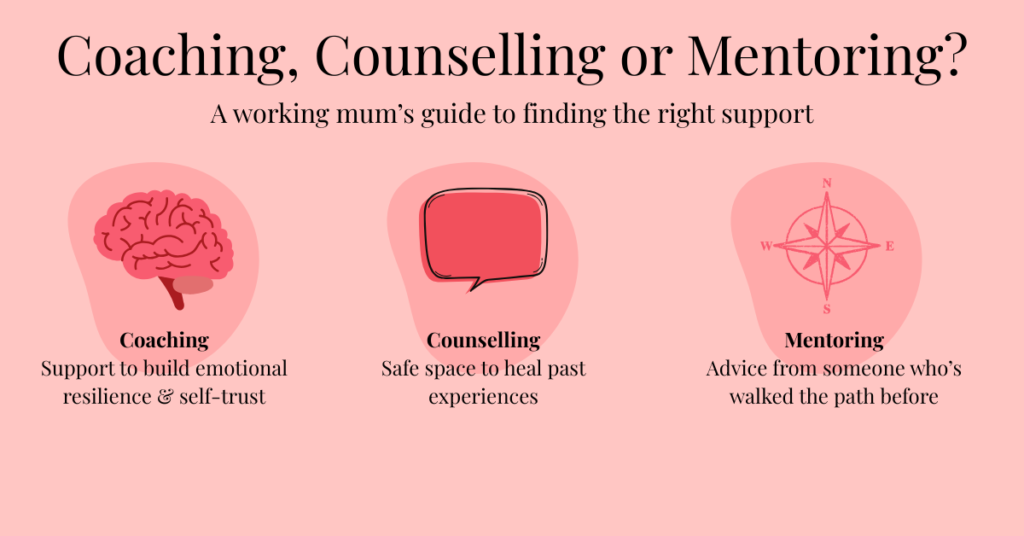
✨ What’s the Difference Between Coaching, Counselling, and Mentoring?

If you’ve ever felt unsure whether you need a coach, a therapist, or a mentor, you’re not alone. So many brilliant, capable women ask the same thing. And the truth is, it can feel confusing—especially when you’re already overwhelmed and stretched thin.

So let’s break it down in simple, no-fluff terms.


Counselling/Therapy: Focus on the Past

Counselling and therapy are often about unpacking past events—especially if they’ve been traumatic or deeply unsettling. It’s incredibly powerful support for when you’re dealing with unresolved pain or emotional wounds that feel hard to shake. These types of support work from the assumption that the event is the problem.

And if that resonates, it might be the right place to start.

But here’s the only downside I see: it can sometimes keep you stuck in the story that the event is the problem, when often the biggest issue is our thoughts about the event.

And you can’t change the past—but you can change how you think about it. That’s where coaching comes in.


Mentoring: Tell Me What To Do

Mentoring is ideal if you’re building something—a business, a career, a team—and you want someone to say: “I’ve done this, do it like this.” Mentors give advice. They guide based on their own experience.

Sometimes that’s exactly what you need. Especially if you’re stuck in decision fatigue and need someone to help map out your next steps.

But if you’re trying to figure out what you want (not just follow someone else’s path)? That’s where mentoring might fall short.


Coaching: Build Your Emotional & Mental Resilience

Coaching is different. As a life coach, I won’t tell you what to do. Instead, I’ll help you figure out what’s right for you.

Together, we look at your thoughts, feelings, and belief systems—and we explore whether they’re helping you move toward the life you really want, or keeping you stuck in loops of guilt, people-pleasing, and overwhelm.

We build self-trust, confidence, emotional resilience—and most of all, clarity. Coaching is future-focused. It’s about where you want to go next, and who you want to become.

This is where it gets really powerful: you already have the answers. Coaching helps you hear them more clearly.


So, Which One Do You Need?

There’s no one-size-fits-all. What matters most is that you resonate with the person supporting you. Whether it’s a therapist, a mentor, or a coach—go with your gut.

The right support doesn’t add to your overwhelm. It helps you release it.

And if you’re curious whether coaching with me is what you need, let’s have a no-pressure chat. Even one conversation can shift something powerful. Click HERE to book your space.

Have you ever actually thought about your thoughts??

Have you ever actually thought about your thoughts??
I know this may sound a bit weird but stay with me.
How you think creates your emotions (it’s been proven by neuroscience, google it 😊).
The urge for sugar, is an emotion. Which means it’s being created by a thought you’re having… what?! I know right?
Your thoughts are creating your desires (and any emotion you have in your life actually, good & bad).
The problem is most of us are not aware of our thoughts. We think we’re just telling the facts.
So, when you think “I just have to eat it”, you think this is a fact. Truth bomb… this is a thought AND a lie that your brain has just given you.
You don’t actually ‘HAVE’ to have it.
When you become aware of these thoughts, when you actually think about what your thinking, now you know what you’re dealing with and can get to work of consciously and deliberately thinking something else.
Have a go and let me know how you got on.
Nicky x
p.s.
I’m amazing at seeing other people’s thoughts so if you’re serious about getting control of your sugar cravings, I can help you.

Book in a free consultation today and let gets started.

What would you choose?

You get to decide if you want to experience short-term gratification or long-term pleasure.

Either way, you’re going to feel uncomfortable.  

At the moment, you are choosing to feel the short-term pleasure the dopamine hit gives you when you eat sugar. But the long-term effects are weight gain, being irritable, experiencing brain fog, sleepless nights, and any other symptoms you may get from eating sugar.

Your primal brain doesn’t care that it’s the sugar causing these long-term effects.  It just wants the instant gratification, and it wants it now!  Just like a child.

But… you could choose to experience the short-term discomfort of feeling the urge for sugar and not eat it, which will actually give you soooo much more long-term gratification. Such as weight loss, balanced moods, healthier body, better night sleep, more respect for yourself.

You actually get to choose this for yourself.

When you leave this decision to your primal brain, it’s always going to choose the instant gratification.

Seriously think about this.  Ask yourself, which one would you prefer?

a)             1.          Having 5 mins of pleasure and years of discomfort?

 2.          Having 5 mins of discomfort and years of pleasure?

Either one includes discomfort, you just get to choose which one.

I know which one I choose, 2.

You get to decide. 

Which is it gunna be?

Weight loss can be easy.

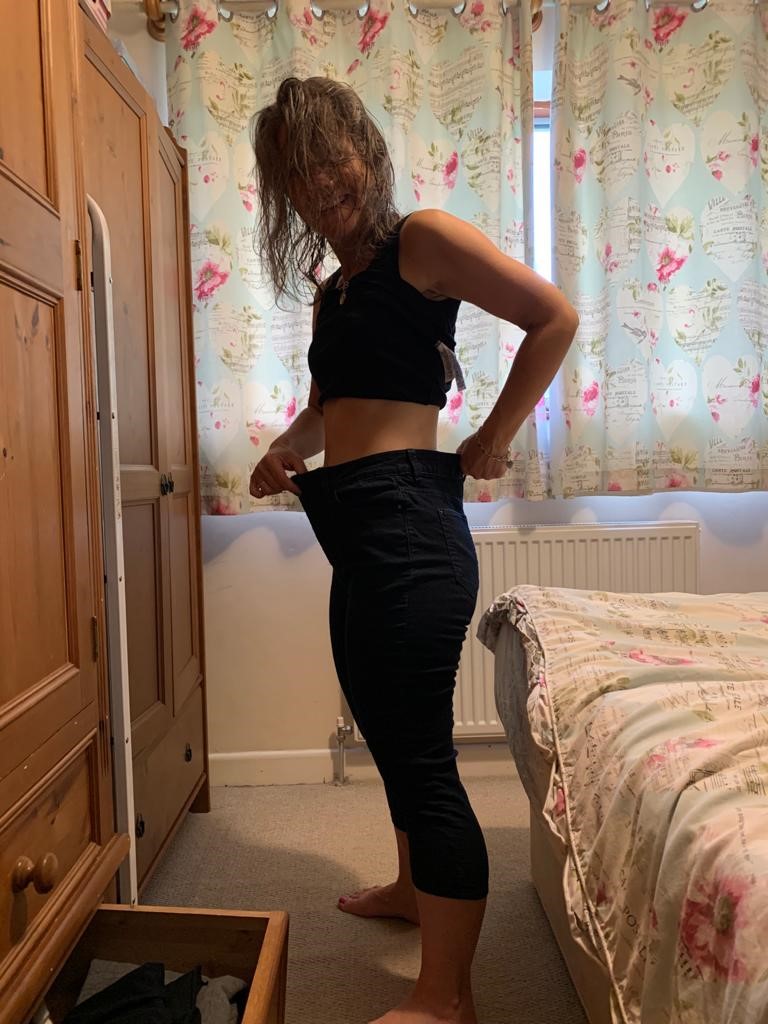
I can’t believe that a year ago these were tight on me!

Even more amazing is how easy it was, and now is to keep off. 

Now that I’ve learnt to manage my mind around food and more importantly sugar, I no longer use food as entertainment. I still enjoy it but don’t need it to make me feel ‘better’.  

I’m not perfect don’t get me wrong. I’m human and my human brain sometimes gets the better of me. But for the most part, I’m in control of what I do or do not, put in my mouth. 

You can do this too. 

You can actually choose what you do, or do not put in your mouth.  

You always have a choice. 

Choose wisely. 

Nicky x

p.s.

If you’re ready to invest in your future and start getting control of your sugar cravings, please get in touch because I can help you. 

I offer a free consultation where we will have a chat and get to know you better. 

Don’t wait, click the button right now and let’s get controlling those cravings.

Your emotions are real.

Your emotions are real.

Let’s not beat around the bush here.

If you are having negative emotions, it’s uncomfortable (that may be an understate for you). But that doesn’t mean to say something has gone wrong.

Nothing is wrong with you if you’re feeling negative.

I’m going to say this again, only a little louder (and with lots of love)… NOTHING IS WRONG WITH YOU, IF YOU’RE FEELING NEGITIVE.

Here’s what you can do, how you process and release the emotion…Answer these questions

  1. Where in your body can you feel it?
  2. Is it a hard or soft sensation?
  3. Is it fast or slow?
  4. What colour is it?

This is how you process an emotion, any emotion, no matter how strong or overwhelming it may feel.When you truly allow the emotion to be in your body, it will then ease and disappear.Trying to eat it away, doesn’t make it go away.Try it and let me know how you get on. 

Have a great week

Nicky x

Have you ever tried to think something different?

Have you ever tried to think something different?

Please just take a second to think about this for a moment… have you ever actually tried to think something different?

Have a go at trying a new thought, just like you would try on a new pair of shoes.

Now, to begin with it may feel a little uncomfortable but the more you think and wear the thought & shoes, the better they feel.

For example, if you might say to yourself “It’ll make me feel better” (it being the biscuits, cake, chocolate) but instead try thinking “Do you know what, it’s not actually going to make me feel better” and just notice how you feel.

You see, it’s what you’re thinking that determines how you’re feeling.

Try this… instead of thinking “I don’t like my body” try on the thought “I have a body”.

The first thought is going to make you feel rubbish and then you’re more likely to eat crap. But the second thought might just make you feel neutral. And, when you’re feeling neutral, you’re more likely to look after your body or at least consider what you’re putting in it.

You can try this with ANY thought you have about ANY situation. You can try on a new thought or a different way of looking at it.

Try it and let me know how you get on.

Nicky xx

p.s.

If you’re ready to start thinking new thoughts about yourself and your life, I’d love to invite you to join in on a free consultation.

In the hour we have together, we will understand more about you and your relationship with sugar and how I can help you further. Because I can help you.